Meeting Myself Through Bodies in The Cadaver Lab with Gil Hedley
I've spent over twenty years actively persuing transformational experiences and would jokingly refer to myself of a “Transformational Junkie”.
Vipasanas in silence, sweat lodges that stripped me utterly raw, countless plant medicine journeys that rearranged my mind, heart understanding of the universe. Conscious BDSM weekends, gatherings, retreats, ceremony after ceremony, each one clearing and breaking me open more and more deeply… And then I spent a week in a cadaver lab with a the Rolfer turned anatomist named Gil Hedley in early October of 2019 and that experience cracked me open more deeply than any other experiences I’ve had to that date.
and now seven years to the date after that lab, I am still integrating pieces of that week long ceremony.
That sentence generally shocks people when I say it out aloud.
Really? A ceremony in a cadaver lab?!
If you’ve ever been in a cadaver lab you might find that sort of remark a bit unsettling and suprising as well. Sensorially it’s overwhelming. The fluorescent lights, bright white walls, the cold stainless steel surfaces and scalpels clattering on trays. The noxious stench of embalming fluid and cleaning liquids, the unique quiet of a room full of bodies that are no longer animated.
To most folks, that doesn’t sound very much like a spiritual practice or practice. It sounds clinical and cold and like the furthest thing from “embodiment work”. But cadaver dissection labs done the way that Gil Hedley facilitates, aren’t just an indepth anatomical science lesson they are truly a rite of passage and an existential excavation.
And for those of us who work with and on and in bodies for a living, as somatic practitioners, bodyworkers, sexologists, pelvic care specialists, massage therapists, or simply as humans exploring how to inhabit our own flesh and humaness more fully… it might be one of the most direct paths back to reverence that exists… at least in my humble opinion.
This is a very short glimpse of the story of what happened in that room, for me. What Gil Hedley's Integral Anatomy approach taught me and why I wholeheartedly believe that every body-based practitioner should consider a cadaver dissection course with him at least once in their life.
What makes Gil Hedley's cadaver labs so different?
Most wet labs in a standard medical school dissection format, are built on a reductionist premise. The donor bodies arrive and more often than not it's parsed into regions for further dissection and assessment. It’s generally cold and divorced from feeling and spirit and our humanity. Here is the arm, there is the thorax, here is the reproductive system et cetera.. et cetera..
Students move from station to station, extracting information very much the way you might extract data from a spreadsheet. The person who once inhabited that tissue is functionally and entire, absent from the room. There is absolutely no consideration for the being that once inhabited that flesh suit. It’s a body on the gurney or just parts of a body… and that’s about it.
Gil Hedley's Integral Anatomy dissections are entirely different. Hedley trained as a Rolfer and holds a doctorate in theological ethics, and in the way he holds these labs, you can very much feel those threads. He calls himself and invites all of us as his students to become, Somanauts. A beautiful word he’s coined for someone devoted to exploring the inner spaces of the human form the way an astronaut explores outer space. Or a psychonaut might explore the recesses of their consciousness with psychedelic medicines. Deeply curious, reverent and with copious amounts of wonder and awe.
The week doesn't open with a scalpel, but with a circle. We stand around the table, hold hands, and are invited into a state of reverence. Bringing ourselves into a state of appreciation for the bodies we're about to work with. This was someone who made a choice, at some point in their life deciding their corporeal form would become a teacher to us after their death. We acknowledge that intention out loud.
Then we work together as a group to sit the body up and then stand it up, so that each participant within the group can meet this person eye to eye. Shaking their hand, if you can call it that… before our work begins. It's a small gesture with an enormous effect which humanised our "cadaver" back into "a person who happens to no longer be alive," and that distinction changes everything about how we interact with and then touch what comes next.
Embodiment as a Relationship with Tissue
Here's the distinction that I feel is integral to anyone doing bodywork, somatics, movement therapy or pelvic care therapy. Anatomy taught this way the way Gil shares in his labs, though highly intellectual concept you memorise. It's a relationship you build.
When you spend hours with your hands inside actual fascia, actual connective tissue, actual muscle bellies — not a diagram, not a plastic model, but the real architecture of a real human being — something shifts in your nervous system. You start to develop an intimate relationship with tissue itself. And the wild part is, it starts to communicate back. I can, months later, drop into a client's shoulder or pelvis and feel that same tissue calling back to me with sensation — a deepened sense of interoception that no textbook diagram ever gave me.
This is the difference between knowing about the body and knowing the body. For sexological bodyworkers, pelvic care specialists, massage therapists, and somatic sex educators, that distinction isn't academic — it's the entire basis of ethical, embodied, effective practice. You cannot guide someone else toward a deeper relationship with their own sensation if your own relationship with tissue is theoretical.
Why the Body Carries So Much Conflict
Part of what made this week so significant is that it forced a confrontation with how conflicted most of us are about our own physicality — especially in cultures shaped by Western religious iconography.
Consider the central image many of us were raised with: a spiritual hero depicted naked and murdered on a cross, and a mother figure revered specifically for having never had sex. Sacrifice and suffering on one hand, purity defined by the absence of desire on the other. It's not hard to trace a direct line from that foundational imagery to the deep discomfort so many people carry around their own bodies, urges, sexuality, and mortality.
A cadaver lab doesn't lecture you about this. It just puts you in a room, hands-on, with the physical reality of a human form — its wonders, its wear, its history — until the abstractions fall away. Anatomy, movement, and sexuality stop being separate categories and start being facets of the same integrated, embodied experience.
The Dream — Dissecting My Own Life
The lab would follow me to sleep each night. Over 42hrs that week immersed in the lab, the smells of humanity, the nausiating stench of embalming fluid, the bright light. By day three of the training, something started happening that I hadn't expected: the work followed me into my dreams.
I assumed, going in, that working on cadavers would create distance. Living bodies are collaborative — when I'm doing bodywork with someone who's breathing, we're in relationship, exploring movement together. A cadaver, I thought, would be different. No longer animated. Just, as the phrase in the training circles goes, an "empty suitcase" — a meat suit with no one left inside.
Instead, I found the opposite. Every time I closed my eyes, I saw the bodies I'd spent the day with — except in the dream, I was the cadaver, and the dissection happening to that body was simultaneously happening to my own life. Layer by layer. Piece by piece. It was raw in a way that's hard to fully translate into words.
What surfaced was a deep continuity between the physical unpacking of a stranger's form and the tedious, unglamorous work of unpacking my own — its stories, its old injuries, its joys, and the deeper viscera most of us keep tucked out of view from the rest of the world. Waking up that morning, I realized I hadn't understood, until that moment, just how significant this training with Gil Hedley was going to be.
What Holds a Human Together
Gil Hedley has spent decades with his hands inside of human tissue, both living and dead. He has, in his own words, dug to the bottom of countless human forms and to the bottom of his own. So when someone asks him a deceptively simple question like, "What actually holds the human form together? What is it made of?" his answer carries significant weight. He doesn't just reach for a simplistic answer like collagen or fascia or connective tissue…. He responds with something else entirely, with “love and grace”.
That answer has stayed with me longer than almost anything else from that week. Hedley doesn’t rejection science, he’s of course a rigorous, credentialed anatomist and somanaut, but it is evident in his labs that the scientific and the mystical aren't at odds, but actually act in support of each other. They're braided together, the same way fascia is interwoven throughout every system in our miraculous bodies into one continuous whole.
Bringing It Back Into the Room With Clients
The way I both viewed the body and touched tissue changed after that week. It was one of those deeply impactful existential moments that was so rich that I am still unpacking in and integrating in layers… now, over 7 years after the fact. I didn't leave that lab and go back to business as usual. The way I hold space for aliveness, grief, pleasure, pain, or shame changed. I stopped thinking of the body as individuated parts to be assessed and started literally feeling it, again and again, as an integrated whole with a story’s, history’s, and yes, an intention. The same way the generous donors of the bodies in that lab had an intention for what would happen to their form after death.
If you work in bodies, as a massage therapist, bodyworker, pelvic floor specialist, somatic sex educator, physical therapist, or any allied practitioner. I'd gently suggest that a week like this isn't optional continuing education. It's is absolutely foundational. You can study anatomy from a screen or books for years and still be working from an incomplete map. Or you can spend a week in relationship with the real thing, hands in, heart open, and come out the other side with a felt sense of the body that no textbook or even hours with hands on bodies can give you.
The Heart as Vortex, Not Just a Pump
One of the most disorienting, beautiful things I learned in that lab concerned the heart.
We're taught from childhood that the heart is a pump. A muscle that acts like a machine which squeezes and pushes blood through pipes. It's a useful model for a biology exam, but it's entirely inaccurate and incomplete. Inside the dissection, watching the architecture of the heart's musculature up close, you see something the pump metaphor can't hold and that’s our heart's fibrous spiral. Blood doesn't just get shoved through the chambers in a straight mechanical stroke, instead the spiraling fibres and tunnels allow the blood to move in a vortex, a continuous spiraling motion that refreshes and renews itself with every beat.
The primary function of the heart, seen this way, isn't just circulation. It's quite literally the restoration of the vorteces… an ongoing act of renewal, built into the very geometry of the organ. That single reframe cracked something open for me clinically and personally. If the heart's job is to keep restoring its own spiral, what does that mean for how we think about emotional and somatic "restoration" in our own lives? What does it mean for clients who arrive holding grief, trauma, or disconnection in the chest — are we helping them pump harder, or are we helping them find their vortex again?
This is the kind of insight that doesn't show up in a standard anatomy textbook, because textbooks are built for extraction of fact, not for relationship with tissue. Gil Hedley's lab is built for the latter.
On the final day of our lab we have dissected the body down to parts. The male body we named Atticus. I took his heart.
I sat hunched over this heart for over two hours. Taking pain-staking care to clean the debris out of each artery, ventrical and veins. Then slowly and methodically dissecting all of the ventricles into a
I sat with his man’s heart in my hands and sobbed. The generousity of spirit for this human to have entrusted us with the tending and care of his body.
About the Author
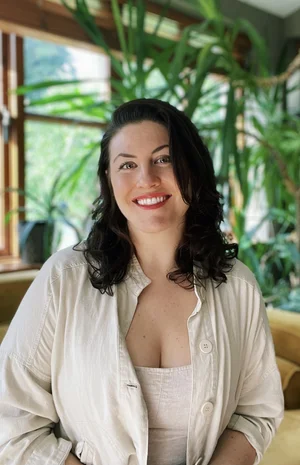
Makia Mullen is a Dublin-based somatic sexologist, integrative pelvic care practitioner, and licensed somatic bodyworker with over 20 years of hands-on experience in the healing arts. Her practice sits at the intersection of body, psyche, sex, and spirit, drawing on training that spans structural bodywork, sexological bodywork, pelvic fascia and scar tissue remediation, and integral anatomy — including in-person cadaver lab study with Gil Hedley focused on pelvic fascia and reproductive anatomy. She supports clients in reclaiming pleasure, restoring sensation, and coming home to their bodies with warmth, curiosity, and play. Learn more at makiamullen.com.